Epoxy Grouting vs Cement Grout: Which Is Better for Singapore Bathrooms?
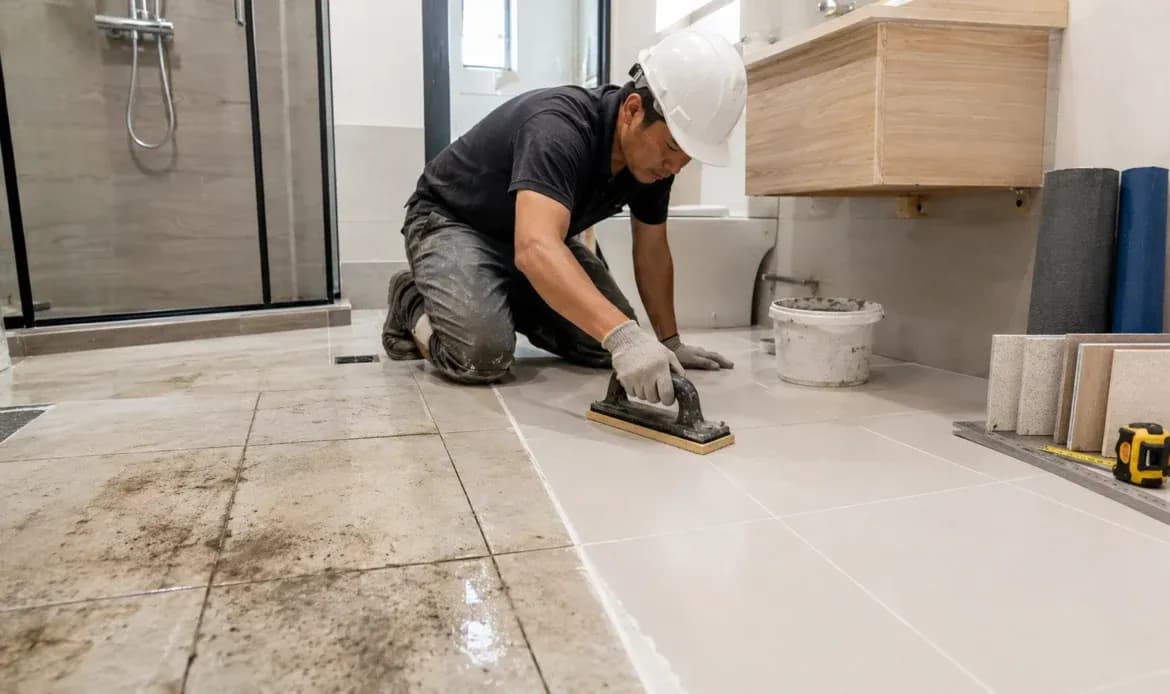
Epoxy Grouting vs Cement Grout: Which Is Better for Singapore Bathrooms?
If your bathroom grout turns black within months of cleaning, you are not alone. Singapore's humidity, combined with daily showers and limited ventilation in many HDB and condominium bathrooms, creates near-perfect conditions for mould to grow in cement grout.
Epoxy grouting has become the go-to solution, but it is not automatically the right choice for every situation. Here is an honest comparison.
What Is Cement Grout?
Cement grout is a mixture of cement, sand and water, sometimes with polymer additives. It is inexpensive, easy to apply and has been the standard for decades.
The problem is porosity. Cement grout absorbs water, and once moisture sits inside the joint, soap scum, dirt and mould follow. Over time the grout darkens, crumbles and becomes difficult to clean no matter how hard you scrub.
What Is Epoxy Grout?
Epoxy grout is a two-part resin system that cures into a hard, non-porous joint. Because it does not absorb water, stains and dirt stay on the surface where they can be wiped away.
It also bonds strongly to tile edges, resists most household chemicals and is far less hospitable to mould and mildew.
Side-by-Side Comparison
Factor | Cement Grout | Epoxy Grout |
|---|---|---|
Water absorption | Absorbs water | Effectively non-porous |
Mould resistance | Low | High |
Stain resistance | Low to moderate | High |
Cleaning effort | High, requires scrubbing | Low, wipes clean |
Indicative cost | Lower | Higher |
Installation difficulty | Easy | Requires experienced applicator |
Typical lifespan | 3 to 5 years before discolouration | 8 to 10 years or more |
Best used in | Dry areas, low-traffic zones | Bathrooms, kitchens, wet areas |
Where Epoxy Wins
Bathroom floors and walls. Constant water exposure is exactly what epoxy is designed for.
Shower areas. Reduced water absorption means less mould behind tiles.
Kitchen backsplashes and floors. Oil and food stains wipe off instead of soaking in.
Balconies and service yards. Rain exposure will not break down the joints.
Households that dislike scrubbing. Epoxy dramatically reduces cleaning effort.
Where Cement Grout Still Makes Sense
Dry interior walls and low-traffic areas where budget is the priority.
Heritage or period-style installations where a softer, matte joint is desired.
Temporary or rental refurbishments where a quick refresh is enough.
Cement grout is not a bad product. It is simply the wrong product for constantly wet environments.
Common Myths About Epoxy Grouting
Myth: Epoxy grout never needs cleaning
It needs far less cleaning, but soap scum and body oils still settle on the surface. A quick wipe is usually enough.
Myth: Epoxy can be applied over old grout
No. Epoxy applied over old cement grout usually fails because it cannot bond properly. The old grout must be raked out first.
Myth: Epoxy grout is always glossy
Modern epoxy grouts come in matte, satin and gloss finishes to suit different tile styles.
Myth: Epoxy is only for new bathrooms
Most epoxy grouting work in Singapore is retrofitting to existing bathrooms, provided the tiles are sound and the old grout can be removed.
How Professional Epoxy Grouting Is Done
Assessment. Joint width, tile condition and the extent of mould are checked.
Grout removal. Old cement grout is mechanically raked out to a proper depth.
Cleaning and drying. Joints are cleaned, treated for mould and fully dried.
Application. Epoxy is worked into the joints and tooled to an even finish.
Clean-up. Residue is removed from tile faces before curing.
Silicone sealing. Corners and movement joints receive flexible silicone, not rigid epoxy.
Frequently Asked Questions
How long before I can use the bathroom?
Light foot traffic is usually fine after 12 to 24 hours, with full water exposure after 24 to 48 hours. Confirm the exact curing window for the product used.
Is epoxy grouting more expensive?
Yes, upfront. But it typically lasts two to three times longer than cement grout and requires far less cleaning, which offsets the cost over time.
Can epoxy grout crack?
Epoxy is rigid, so it can crack if the substrate moves significantly. That is why corners and movement joints use silicone instead.
Will it stop mould completely?
It removes the porous surface mould feeds on, but surface mould can still grow on soap scum. Regular cleaning and ventilation remain important.
Considering Epoxy Grouting in Singapore?
Asrafi Renovation Pte Ltd provides bathroom, kitchen and living area epoxy grouting with proper grout removal, mould treatment and silicone sealing.
Call or WhatsApp +65 8464 2371 or visit 101 KITCHENER ROAD, #03-04A, JALAN BESAR PLAZA, SINGAPORE 208511. Open daily, 9am to 10pm.
Found this helpful? Share it.